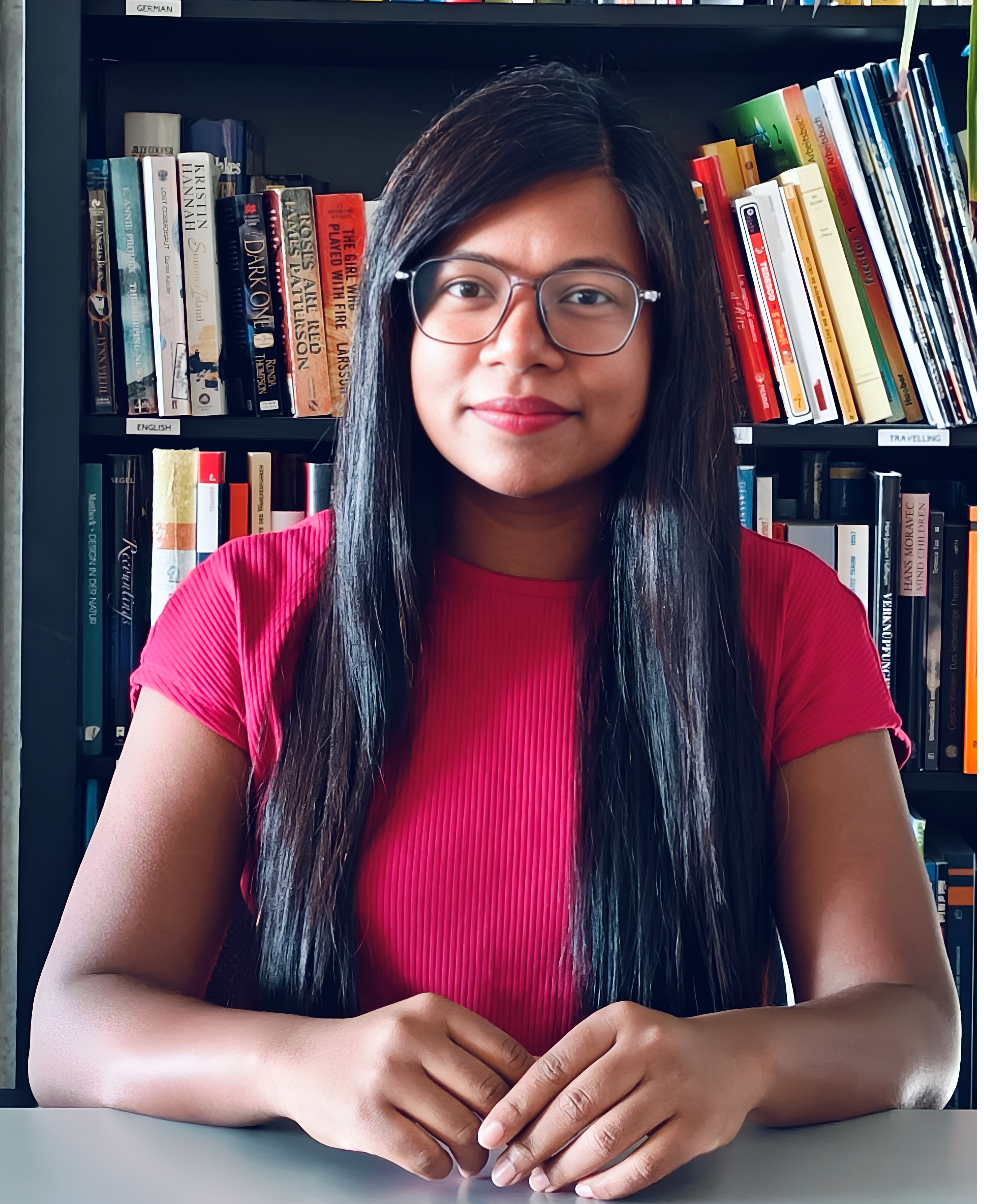
Dr. Anima Kujur
Address
Interdisciplinary Center for Scientific Computing (IWR), Heidelberg
Im Neuenheimer Feld 205 - MΛTHEMΛTIKON A, Second floor, Room: 2/328
69120 Heidelberg
Germany
Email: anima.kujur@iwr.uni-heidelberg.de
Office hours: By arrangement
About Me
I am an interdisciplinary computational researcher working at the intersection of artificial intelligence, dynamical systems, and biomedical science. My research focuses on developing interpretable and structurally informed machine learning models for complex biomedical data,particularly neuroimaging and physiological time-series signals. During my PhD, I worked extensively on deep learning–based medical image analysis, developing convolutional neural network architectures for radiological image segmentation, classification, and multimodal neuroimaging analysis for neurological diseases such as brain tumors and Alzheimer’s disease. In my postdoctoral research, I expanded my work into nonlinear dynamical systems and operator-theoretic approaches, particularly Koopman-based modeling, to analyze and reconstruct neural dynamics in physiological signals such as EEG, LFP, and fMRI time series. My research combines applied AI workflows with dynamical systems–informed modeling to better understand latent system dynamics and improve robustness, interpretability, and reliability in biomedical AI systems. My long-term research vision is to develop innovative, interpretable, and translational AI tools that bridge machine learning, computational neuroscience, and biomedical research to better understand complex biological systems and support real-world health applications.
Research Interests
- Nonlinear Dynamical Systems & Time-Series Modeling: Modeling complex dynamical systems, analysis of nonlinear attractors (Lorenz, Rössler, Van der Pol), latent dynamical representations, and forecasting of physiological and biomedical signals.
- Operator-Theoretic Learning: Koopman-based representation learning, spectral analysis of dynamical systems, and interpretable latent dynamics modeling.
- Computational Neuroscience & Neural Signal Analysis: Analysis of EEG, LFP, and fMRI signals, neural dynamics reconstruction, transient brain activity modeling, spatio-temporal learning, and physiological signal forecasting.
- Artificial Intelligence & Machine Learning: Deep learning for biomedical data, CNNs, RNN/LSTM, representation learning, and operator-theoretic AI approaches, Dynamic Mode Decomposition (DMD), and Extended DMD (EDMD).
- Medical Image Analysis & Multimodal Neuroimaging: MRI, CT, and multimodal neuroimaging analysis, radiological image segmentation, disease classification, multimodal data fusion (MRI–fMRI), and AI-driven diagnostic modeling for neurological disorders.
- Interpretable & Dynamically Structured Machine Learning: Mechanistically informed AI models, interpretable latent representations, and training dynamics analysis.
- Robust & Translational AI for Biomedical Systems: Developing reliable AI workflows, cross-dataset generalization, bridging computational modeling with real-world biomedical and health applications.
Publications
Research Articles
- Anima Kujur, Zahra Monfared, and Shervin Safavi, “Transient Neural Dynamics Reconstruction”, NeurIPS 2025 Workshop on Learning from Time Series for Health.
- Ahmed Alshembari, Anima Kujur, and Zahra Monfared, “Autoregressive ConvLSTM Framework for Predicting fMRI Time Series Forecasting in Alzheimer’s Disease”, NeurIPS 2025 Workshop on Learning from Time Series for Health.
- Anima Kujur, Zahra Monfared. “Multimodal Deep Learning for Dynamic and Static Neuroimaging: Integrating MRI and fMRI for Alzheimer Disease Analysis”, TechRxiv February 20, 2026, DOI: 10.36227/techrxiv.177155636.68666321/v1.
- A. Kujur and Z. Raza, “High-Fidelity Radiological Image Segmentation with Deep Learning:The AbED-Net Framework for Clinical Diagnosis”, 2025 IEEE 4th World Conference on Applied Intelligence and Computing (AIC), GB Nagar, Gwalior, India, 2025, pp. 606-611, doi:10.1109/AIC66080.2025.11211956.
- A. Kujur and Z. Raza, “Deep Learning-Driven COVID-19 Lesion Segmentation in CT Scans with R-EDNet”, 2025 3rd International Conference on Communication, Security, and Artificial Intelligence (ICCSAI), Greater Noida, India, 2025, pp. 368-373, doi: 10.1109/ICCSAI64074.2025.11064039.
- Anima Kujur, Zahid Raza, Arfat Ahmad Khan and Chitapong Wechtaisong, “Data Complexity Based Evaluation of the Model Dependence of Brain MRI Images for Classification of Brain Tumor and Alzheimer’s Disease,” in IEEE Access, vol. 10, pp. 112117-112133, 2022, doi: 10.1109/ACCESS.2022.3216393.
- Kujur, A. and Raza, Z. (2023) “Performance analysis of 3D brain MRI modalities for brain tumour sub-region segmentation using U-Net architecture”,Int. J. Electronic Healthcare, Vol.13, No. 4, pp.311–337, doi: 10.1504/IJEH.2023.138256.
- Kujur, A., Raza, Z. (2024). “DUNET Dilated UNET for Brain Tumor Sub Region Segmentation using MRI Images”, Defence Life Science Journal, 9(3), 282–289. https://doi.org/10.14429/dlsj.9.19183
Poster Presentation
- Anima Kujur, Zahra Monfared, and Shervin Safavi, “Koopman-based Transient Dynamics Reconstruction”, Computational and Systems Neuroscience (COSYNE), Lisbon, Portugal, 12-17 March 2026.
- Anima Kujur, Zahra Monfared, and Shervin Safavi, “Transient Neural Dynamics Reconstruction”, Workshop on Learning from Time Series for Health at The Thirty-Ninth Annual Conference on Neural Information Processing Systems (NeurIPS), San Diego, CA,USA, December 2-7, 2025.
- Ahmed Alshembari, Anima Kujur, and Zahra Monfared, “Autoregressive ConvLSTM Framework for Predicting fMRI Time Series Forecasting in Alzheimer’s Disease” Workshop on Learning from Time Series for Health at The Thirty-Ninth Annual Conference on Neural Information Processing Systems (NeurIPS), San Diego, CA, USA, December 2-7, 2025.
- Alshembari Ahmed, Kujur Anima, and Monfared Zahra, “Deep Spatio-temporal Learning in fMRI Sequence Prediction for Alzheimer’s Disease”, at Heidelberg University, Germnay, 2025.
- Mahshid Baharifar, Anima Kujur, and Zahra Monfare, “Interpretable AI for Classifying Human-and LLM-Generated Medical Misinformation with Multi-Modal Features”, at Heidelberg University, Germnay, 2025.
- Anima Kujur, Juergen Hesser, Tobias Meißner, and Zahid Raza, “Integrating 3D Multimodal CNNs for Brain Tumor Radiogenomic Classification: MGMT Promoter Methylation Prediction in Glioblastoma from mpMRI Fusion,” MCTN Symposium Imaging in Neuroscience, University Medical Centre, Mannheim, Germany, 7 Dec 2023.
Awards and Fellowships
- Senior Research Fellowship (SRF): Government of India, 2022–2024.
- Junior Research Fellowship (JRF): Government of India, 2019–2021.
- Qualified National Eligibility Test (NET): Assistant Professor, India, 2019.
Internships and Collaborations
- MGMT Promoter Methylation Prediction in Glioblastoma: Visiting research scholar at Mannheim Institute for Intelligent Systems in Medicine, Germany, 2023.
- Modeling Dynamical Systems: Internship at Heidelberg University, Germany, 2019.
- Neural Networks and Network Topology: JNU, India, 2019.
Other Experiences
- Tutor: HeiAIMS Summer School on Applied Mathematics and Scientific Computing, Cape Town, South Africa, 2024.
- Workshops and Leadership Programs: Participated in several international training sessions.
- Teaching: Educator at St. Xavier’s School, Chhattisgarh (2020–2021).
- Reviewer: Peer-reviewed 8 articles for IEEE Access.